GridPilot now knows when your Sunday roast goes on
Every GridPilot system has started building a picture of how your household actually uses power — so it can plan for the evening rush instead of being surprised by it.
Here’s a situation that used to catch smart battery systems out.
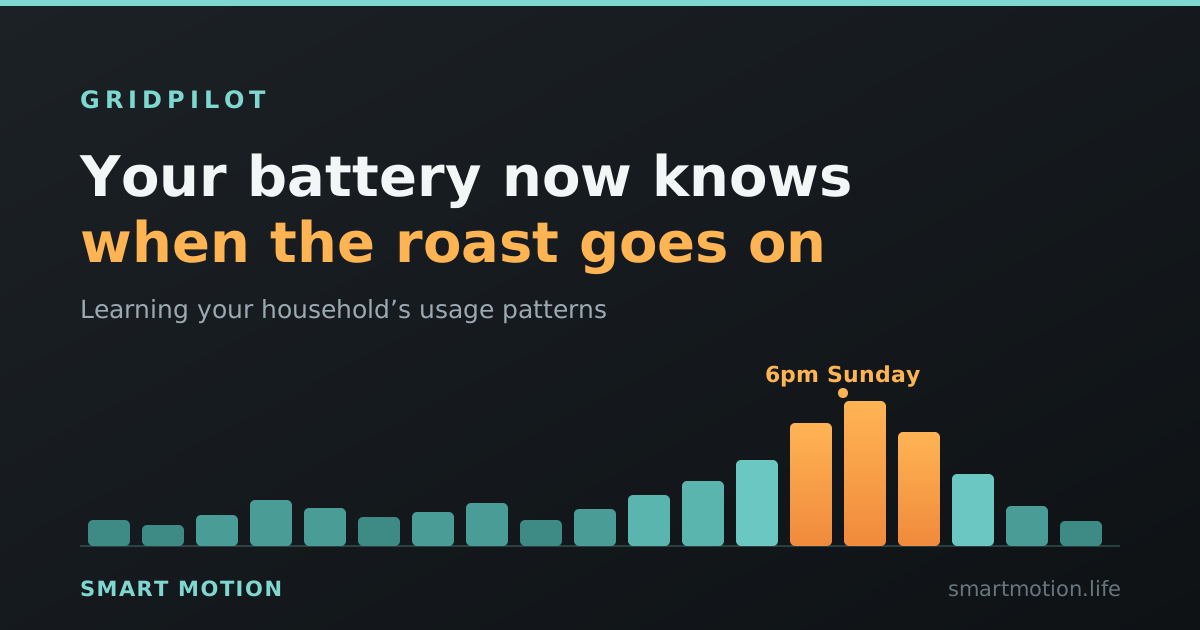
It’s 3pm on a Sunday. The house is quiet. Everyone’s out, or reading, or having a nap. Power usage is sitting at a gentle half a kilowatt. Your battery is at 60%, and to any system looking only at right now, that looks like plenty.
Then 5pm arrives. The oven goes on for the roast. The ducted heating kicks in as the temperature drops. Someone puts a load of washing on. Suddenly the house is pulling six times what it was an hour ago — right as grid prices hit their evening peak, which is exactly when you least want to be buying power.
The old answer was to look at the last half hour of usage and assume the next few hours would be similar. That works fine at 11am on a Tuesday. It works badly at 3pm on a Sunday.
What’s changed
GridPilot now takes a reading of your household’s power use every two minutes, around the clock, and builds up a picture of what a typical week looks like in your home specifically.
Not an average. Not a generic household profile. Yours — broken down by every half hour of every day of the week.
Over time it learns things like:
- Your Sunday evenings are consistently heavier than your Tuesday evenings
- You’re a household that gets going at 6am, not 8am
- Saturday middays are busy, Sunday middays aren’t
- The heating comes on around 4:30pm in winter, not 6pm
None of that is anything you have to tell it. It just watches and learns.
Why it matters for your bill
When GridPilot decides how much charge to hold back in your battery, it’s answering a question: how much power is this house going to need before cheap energy comes around again?
Get that number too low and the battery runs flat during the expensive evening peak, and you buy power at the worst possible price. Get it too high and you’re sitting on charge you could have exported while prices were good.
Usage history sharpens that number considerably. Instead of assuming the next six hours will look like the last thirty minutes, GridPilot can now plan against what your house genuinely tends to do at that time, on that day.
In practice, that means fewer evenings where the battery runs out just as prices spike — and less charge hoarded on the quiet nights where it wasn’t needed.
A few things worth knowing
It never overrides what’s actually happening. History informs the plan; live readings still run the show. If your house is drawing heavily right now, GridPilot responds to that immediately, regardless of what history says is typical. The learned profile can only ever make the system more cautious about the hours ahead — never less.
It adapts. The system weights recent weeks more heavily than older ones. Buy an electric car, install a pool pump, have the kids move out — the profile follows along within a few weeks. It’s not locked to whatever it saw last summer.
Your data stays with your system. This is your own home’s usage information, collected from your own Home Assistant, used for one purpose: running your battery well. It isn’t sold, shared, or pooled with other customers.
You don’t need to do anything. No app update, no settings to change, nothing to install. It’s already running.
When you’ll notice it
The learning is underway now across every GridPilot site. A profile needs to see the same time slot on the same weekday several times before it’s trustworthy, so the system deliberately holds off using it until there’s enough data to be confident — roughly the next few weeks.
After that, you may start seeing GridPilot mention it in the plain-English explanations on your dashboard. Something along the lines of: “Holding charge — this home usually uses a fair bit around 6pm.”
That’s your Sunday roast, showing up in the maths.
Questions about your GridPilot system? Get in touch — we’re always happy to walk through what it’s doing and why.